• timber
• metal
• plastic/synthetic
• composite
• miscellaneous
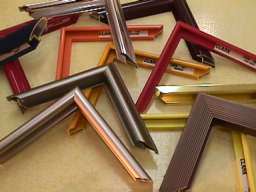

| Timber | |
Timber used for picture framing should exhibit the following characteristics: The common timbers used in picture framing in Australia are: Of the above, pine is the most ecologically sound because it is harvested from sustainable forests. Ramin is the most used timber for picture frame moulding because it has a close pale and even grain. Ramin is a dense hardwood and thus it takes intricate shaping well. Jeluton and ramin are both rainforest timbers of South East Asia. Obeche is a light-weight hardwood from West Africa. It is used predominantly by Italian manufacturers to make larger profile mouldings. |
|
| How Timber Mouldings are made | |
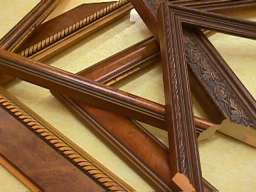
Timber mouldings are made by passing lengths of wood, that have been cut approximately to size, through a moulder. A spindle moulder or profiler shapes the timber by passing it through a series of cutting heads. An infinite variety of profiles is possible. After shaping, timber moulding can be embossed with a pattern that is applied by machine. The desired pattern is engraved on a metal stamping wheel. The wheel is heated by a gas jet. The moulding is fed beneath the wheel under pressure and the heat embosses the pattern into the timber. Timber mouldings can be finished by many different techniques. Some of these finishes include: Timber mouldings are often gessoed to cover any defects. Gessoing is a process of applying several layers of a white coating made from chalk and glue. Gessoed moulding gives a smooth base for many painted and gilded finishes. |
 |
back to categories list  |
|
| Metal | |
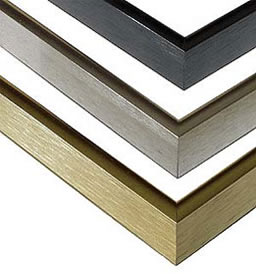
Metal frames are made of brass, copper and silver. However, the most common metal used to make picture frames is aluminium. Aluminium frames are made in a length by an extrusion process. The lengths are finished by either painting or anodising. Anodising is the electrodepositing of an oxide coating.
|
 |
| back to categories list |
|
| Plastic / Synthetic |
|
Plastic mouldings can be grouped into several categories: Plastic boxes are usually used for temporary artifact or print display where artworks have to be protected and changed easily. Plastic laminated wood is a useful product because of the consistancy of finish is maintained from one batch to the next. It allows for the timber base to be made from a finger-jointed pine which holds its shape quite well and is relatively economical. Solid plastic mouldings have been used by volume frame manufacturers for some time. The range of plastics available to the custom picture framer is growing and the finishes are becoming more acceptable. With the shortage of quality timber, plastics will become more prominent in the picture framing industry. Plastic section mouldings are similar to metal extruded mouldings and require special components to facilitate joining. |
|
| back to categories list |
|
| Composite |
|
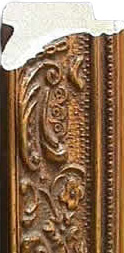
Composite can be taken to mean several different types of mouldings: Timber mouldings with applied ornaments can be made by two methods: Machine made ornamental mouldings are made by passing the moulding through a machine similar to an embossing machine. The difference is, instead of burning the design into the timber, the pattern is moulded into a compound. The compound is either a wood pulp mixture or a composition mixture made from resin, glue and chalk. Handmade ornamental mouldings are usually made after the moulding has be cut and joined into a frame. |
 |
| back to categories list |
|
| Miscellaneous |
|
Miscellaneous materials used for manufacturing frames include: |
|
| back to categories list |
|